
Operations · Sep 22, 2026 · 9 min read
Top Tools for Managing a Chauffeur Service Efficiently (2026)
By Limozoft Editorial · Reviewed by Limozoft operator research team.
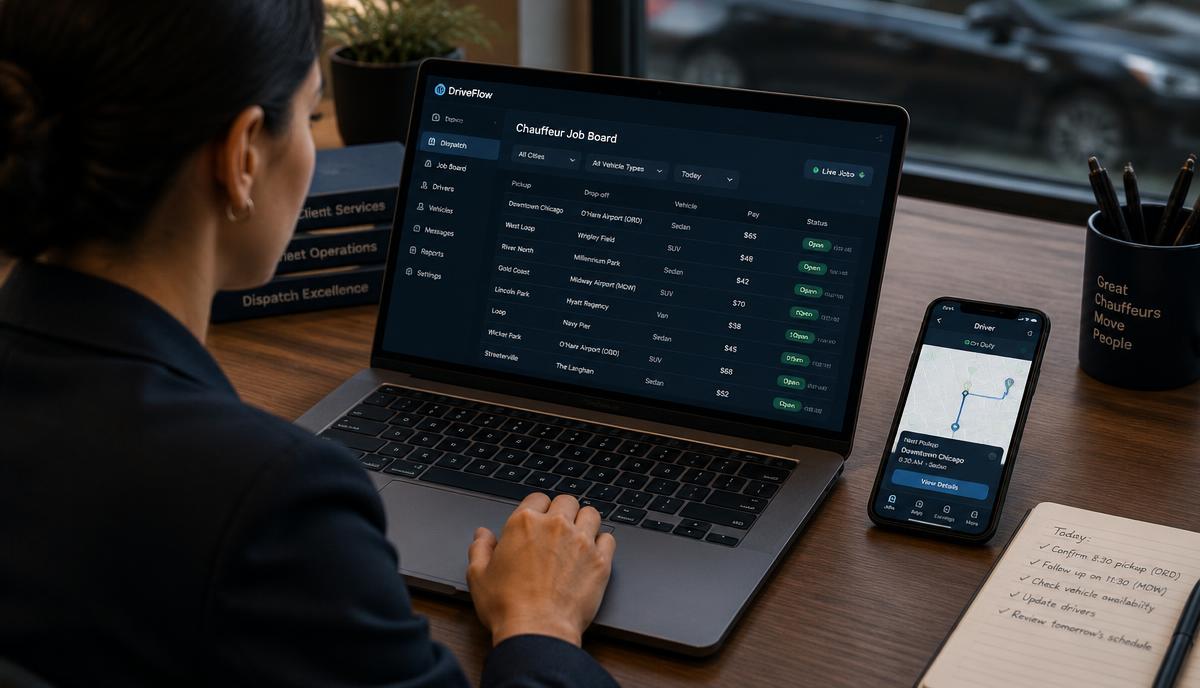
What tools does a chauffeur service actually need?
Efficiency in a small chauffeur operation is not about having more software. It is about how few times a single trip has to be re-typed. Every hand-off between tools — website to inbox, inbox to spreadsheet, spreadsheet to driver WhatsApp — is where an airport pickup gets lost.
- Dispatch board — today, tomorrow and unassigned jobs, with driver and vehicle assignment.
- Driver app — job sheet, accept/on-route/complete, navigation hand-off, passenger signature.
- Booking widget — quote and book on your own domain, not a third-party marketplace.
- Payments — card capture, pre-authorisation, and receipts that itemise gratuity and surcharges.
- Corporate accounts — PO numbers, cost centres and consolidated monthly invoices.
- Payout tracking — completed trips, commission, tips, net pay, exportable for your bookkeeper.
Which tools can a small operator safely skip?
Plenty of enterprise features are sold hard and used rarely below 20 vehicles. Automated driver settlement across multiple commission schemes matters at 100 drivers; at eight drivers a monthly export takes twenty minutes. Multi-depot configuration, certified in-vehicle telematics and revenue-management engines are the same story.
- Multi-depot / multi-base configuration — single-base operators pay for surface they never touch.
- Automated per-driver settlement engines — a CSV export covers you until roughly 25 drivers.
- Standalone CRM subscriptions — customer history belongs next to the reservations, not in a separate tool.
- Separate quoting tools — a quote that cannot become a booking in one click is a leak, not a feature.
Should you buy one platform or best-of-breed tools?
Best-of-breed wins when each tool is genuinely better and someone on staff owns the integrations. That is rarely true of a three-car company where the owner also drives weekends. One platform wins on the metric small operators feel daily: the number of places a trip exists.
For context on stacked pricing: Limo Anywhere publishes its pricing openly and bills month-to-month (per limoanywhere.com/pricing, August 2026), with Core covering up to 500 trips a month, but a small operator usually also adds the branded passenger app ($199 setup + $99/mo) and messaging ($39/mo), plus a $299 one-time license fee.
How do you measure whether the stack is working?
Pick four numbers and track them monthly. If a tool does not move one of them, it is overhead.
- Minutes from enquiry to confirmed booking.
- Share of bookings taken online versus by phone.
- No-show and late-pickup count per 100 trips.
- Days from trip completion to invoice paid.
Six tools, two ways to buy them (September 2026)
| Capability | Bought separately | Included in Limozoft |
|---|---|---|
| Dispatch board | $50–$150/mo | Included |
| Native driver app | Often a per-driver add-on | Included |
| Booking widget on your site | Website project + plugin | Included in the $399 build |
| Card payments | Stripe fees at cost | Stripe at cost, billed to you |
| Corporate PO billing | Higher tier on most platforms | Included |
| Driver payout tracking | Spreadsheet or payroll add-on | Included |
Pros and cons
Pros
- One record per trip — no re-typing between website, dispatch and driver
- Predictable monthly cost regardless of booking volume
- Corporate PO billing available at the entry tier
Cons
- Not a fit for 100+ vehicle or multi-depot operations
- No GNet integration or certified in-vehicle telematics
- As of September 2026 Limozoft has no first-party Capterra, G2 or GetApp reviews
Keep exploring on limozoft.com
Dispatch console →
The real-time board dispatchers learn in an afternoon.
Chauffeur driver app →
Native iOS/Android, included on every plan.
Booking widget →
Embed on your site in five minutes.
Solutions by fleet type →
Airport, corporate, black car, wedding & small fleet.
Frequently asked questions
What is the minimum software a 3-car chauffeur company needs?+
Can I run a chauffeur service on spreadsheets and WhatsApp?+
How much should a small chauffeur operator spend on software?+
Ready to see it live?
Book a 20-minute demo tailored to your fleet.
Same-week launch · month-to-month · everything included.
Related reading

Operations · 8 min
How Chauffeur Companies Automate Daily Operations (2026 Playbook)

Operations · 9 min
How to Streamline Limo Dispatch Operations (2026)

Operations · 9 min
How to Manage Limo Bookings Efficiently (2026 Playbook)

Operations · 8 min
What Software Should I Use to Track My Chauffeur Fleet?
Where to go next on Limozoft
- Limo Anywhere pricing, broken down line by line — what the bill really comes to once add-ons are stacked.
- Limozoft pricing — $399 one-time + $10–$40/mo with every feature included.
- Limozoft vs Limo Anywhere — the 2026 head-to-head on pricing, setup time, driver app and contract terms.
- Best dispatch software for small limo operators (1–15 vehicles).
See Limozoft on your own reservation data.
20-minute walkthrough. No slide deck. Same-week launch.
Book a free demo →